Power Resiliency Solutions
Power Resiliency Solutions for Facilities That Cannot Afford Downtime
Power resiliency gives organizations the ability to actively manage the impact of energy disruptions on business. Instead of reacting after outages occur, facilities can decide which operations stay online and how risks are mitigated.
Resiliency solutions, such as distributed energy resources, address the growing costs that facilities face from grid outages. For organizations dependent on continuous operations, power resiliency maintains critical functions during grid disturbances without additional stress.
In operational terms, power resiliency sustains critical power continuity across systems through coordinated planning, infrastructure and long-term management. At its core, power resiliency puts control back in the hands of facility owners and operators.
Control Your Energy Outcome
Organizations gain the ability to plan for disruption scenarios and design power systems that align with business priorities. This approach goes beyond basic backup power by focusing on operational power resilience, downtime risk reduction and predictable performance under stress.
For organizations seeking greater certainty can go beyond reactive recovery and focus, instead, on a proactive energy strategy. Resilient power systems should work so operators can seamlessly coordinate assets and maintain continuity on their own terms. At scale, power continuity solutions should support resilient power systems that protect mission-critical operations before, during and after disruptions.
PowerSecure delivers enterprise power resiliency solutions that support power outage mitigation, protect critical facilities and help organizations maintain confidence in their operations under both routine and extreme conditions.
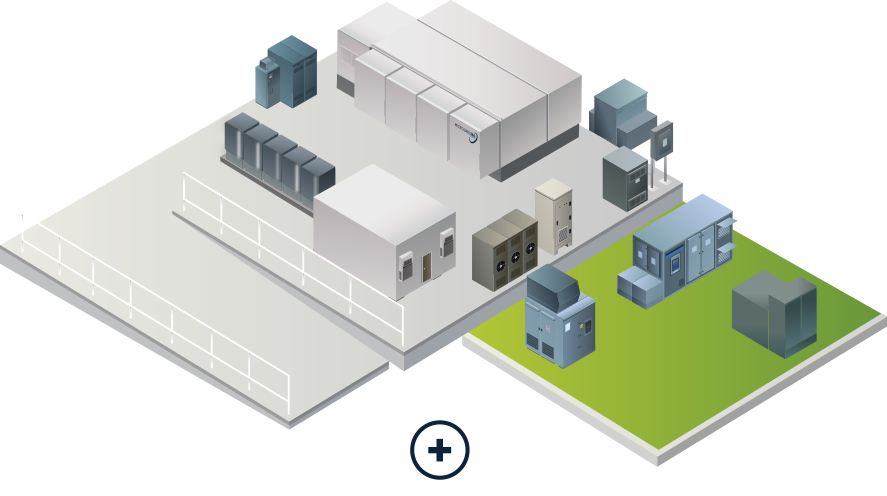
Welcome to our Microgrid
As a localized group of electricity generation sources, storage options and loads, a microgrid is typically connected to the centralized grid and can run synchronously with it, but can be islanded and operated autonomously as needed. This provides backup in cases of emergency while also cutting costs and allowing communities to be more energy independent. PowerSecure’s onsite microgrid features:
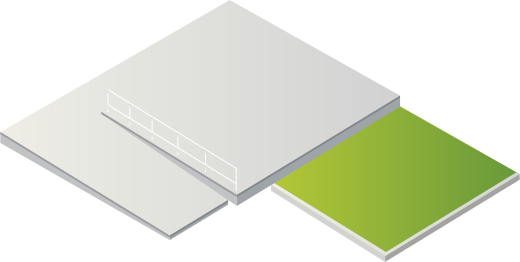
NexGear switchgear
NexGear Switchgear connects the AC output of the microgrid to the rest of the system.
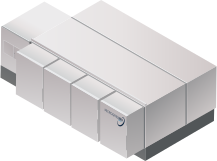
Powerblock
Fully integrated power generation system which includes two 625kW EPA Tier 4 Final diesel engines, controllers and monitoring software in our 4-bank PowerBlock enclosure.
Fuel Cells
Fuel Cell distributed power generation system which provides always-on, primary power. System includes 50kW, 480VAC power source fueled by natural gas.
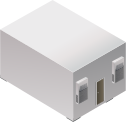
Battery Energy Storage System
The Battery Energy Storage System is 852.32kWh, equaling 500kW, with 704-913 VDC and 0.5 C-battery rating.
Power Equipment Center (PEC)
The PEC encloses the Battery Energy Storage System and the DC Switchgears. The switchgear components interconnect energy storage, fuel cells and the photovoltaic (PV) system into a single output.
Inverters
Photovoltaic Inverter
Regulates the power flow from the rooftop solar system to the microgrid.
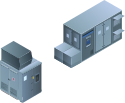
Fuel Cell Load Bank
This load bank system serves the Fuel Cells in using its energy output to test, support or protect the power source in the event of an outage.
Utility Transformer
The connection point to the utility power source.
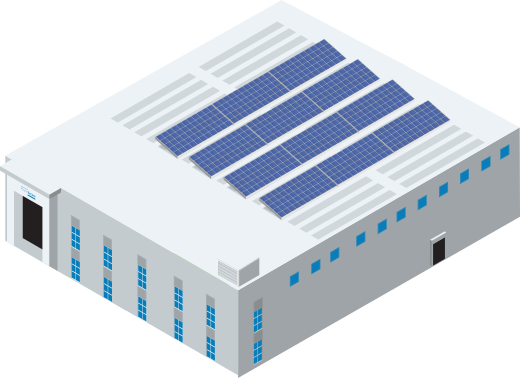
Solar
PowerSecure's 200kW PV system, with 47 strings of 12 PV modules, serves as a renewable fuel source for the microgrid.
Fuel Cell Load Bank
This load bank system serves the Fuel Cells in using its energy output to test, support or protect the power source in the event of an outage.
Fuel Cell Load Bank Emergency Switch
Microgrid Transformer
The Microgrid Transformer equals 1000kVA.
EXPLORE THE COMPONENTS OF AN ADVANCED MICROGRID.
Your Role in Power Resiliency Planning
Power resiliency is most effective when organizations take an active role in shaping their energy strategy. This includes defining acceptable downtime thresholds and planning for how power systems should perform under different disruption scenarios.
With the right infrastructure and operational support, facilities can move beyond emergency response and toward intentional energy strategy where performance, uptime and risk exposure are proactively controlled.
Microgrid Power Systems as the Core of Power Resiliency
A microgrid is a form of distributed energy resource that can operate in parallel with the utility grid or independently through islanded power operation when grid power is unavailable or unstable. Microgrid systems form the foundation of modern energy resilience solutions because they’re designed as coordinated power systems rather than isolated assets.
Microgrid resiliency solutions help coordinate generation, controls and loads in real time, allowing facilities to prioritize critical loads and manage transitions without interruption. This coordination gives facilities direct influence over how power is used during normal operations and abnormal conditions.
Microgrid systems, such as those designed by Powersecure, can meet different resiliency objectives based on risk exposure and operational requirements. Advanced microgrid solutions integrate multiple energy generation resources, energy storage and sophisticated controls for environments that require greater flexibility. In situations that demand rapid deployment or temporary support, mobile microgrids provide firm, on-site power without long construction timelines.
Operational Capabilities That Sustain Power Resiliency Over Time
Power resiliency depends on sustained performance, not just proper installation. Long-term reliability requires monitoring, service and planning that keep systems ready for real-world conditions. Without continuous oversight, even well-designed systems can lose effectiveness.
Real-time monitoring supports power quality, system visibility and early issue detection across redundant power infrastructure. High visibility helps operators can maintain stable performance and respond quickly to emerging risks.
Preventive service is another core element of power resiliency planning. Regular testing, inspections and fuel management reduce unplanned downtime and extend system life. PowerSecure integrates preventive maintenance into power solutions for consistent performance.
And where appropriate, participation in demand response programs allows systems to align with grid conditions and utility needs while supporting facility operations and maximizing your return on investment.
CASE STUDY
Reid Hospital
Read how a microgrid system supported Reid Hospital resiliency and actually helped them earn money back on their investment.
Power Resiliency Solutions Designed Around Industry and Risk Profiles
Power resiliency requirements vary significantly by facility type and risk profile. Factors such as safety, regulatory exposure, uptime tolerance and financial impact all have an impact on how resiliency solutions are created.
Power reliability for critical facilities such as data centers, healthcare environments and government facilities is often required due to safety and service obligations. Other industries, like manufacturing, retail and logistics, face operational risks tied to production downtime, inventory loss and supply chain disruption. Public and defense organizations, including utilities and military installations, prioritize continuity for essential services and mission readiness.
Effective planning starts with understanding critical loads, disruption scenarios and long-term objectives. When business plan accordingly, they get resilience during outages, and greater certainty in how energy supports business operations every day.
Energy resilience isn’t about reacting faster—it’s about deciding earlier.
Evaluating power solutions? Contact PowerSecure to discuss on-site power resiliency strategies aligned with operational and risk requirements.